
resources · alert & warning
Alerting Is a System, not a send
By Corey Dierdorff, MPIO · July 11, 2026 · 7 min read
A brush fire crests the ridge above town at 3:30 p.m. The wind is pushing it downhill at the speed of a car. The people in its path are at work, at school, scrolling their phones, doing nothing about a fire they do not know exists.
You have minutes to change that. Hitting send is the easy part. Making the warning land is the whole job.
A warning works only when the right people receive it, understand it, believe it, and act on it in time. Each of those is a link in a chain, and the public lives or dies by the weakest one. Your job is not to issue a warning. It is to get a protective action taken.
What a warning has to carry.
Decades of warning research keep landing on the same short list. An effective alert carries five things, and dropping any one of them makes people hesitate at the moment they cannot afford to.
- Source. Who is telling me this, and can I trust them. Name the agency.
- Hazard. What the threat is, in plain words. Not an incident. A fast-moving brush fire.
- Location. Where, specifically. A named neighborhood or a clear boundary, not the area.
- Guidance. What to do, as one clear action. Evacuate now toward the south. Not be aware.
- Time. When. Now, or by a stated deadline.
Write for a person who is scared and distracted, not the calm reader at a desk. Short words. One action. The specific street instead of the vague region. A warning that makes someone stop and wonder what it means has already cost you the minutes you were trying to buy.
The right channel, the right polygon.
Remember the grass fire outside Boulder that hit 100-mph winds and became an urban firestorm in the time it takes to drive across town. Some neighborhoods got reverse-911 calls and phone alerts. Others sat in subdivisions where the county's opt-in warning system reached only the handful of residents who had ever signed up. Two streets over from a family that got the call was a family that got nothing.
The fire did not choose who to warn. The system did. No single channel reaches everyone, so you have two jobs.
Stack the channels.
- WEA and IPAWS push to every capable phone inside a target area with no signup required. This is your widest no-enrollment reach.
- EAS rides broadcast TV and radio. NOAA Weather Radio covers the weather-radio households.
- Outdoor sirens reach people who are outside and away from a screen.
- Opt-in mass notification is precise and rich, and limited to enrollees.
- Social media reaches the connected, and the people who reshare to everyone else.
- Route alerting and door-to-door reach the population with no working tech at all.
Match the stack to who actually lives there. A retirement community, a non-English-speaking neighborhood, and a state park full of visitors are three different reach problems.
Aim the polygon. WEA and IPAWS let you draw the area that gets the alert. Draw it too wide and you trigger a shadow evacuation: people who were never in danger clog the roads the real evacuees need, and the over-warning teaches everyone to ignore your next alert. Draw it too narrow and you miss the people at the edge of the hazard. Draw to the hazard plus a margin, and say plainly who is included and who is not.
The clock and the call.
Think of a hurricane in the Gulf with a forecast track that keeps sliding. Some coastal counties call mandatory evacuations early. One large county waits, watching the cone, hoping for a clearer picture before it moves hundreds of thousands of people. By the time the order comes, the window to leave is closing and the water is rising.
The forecast was genuinely uncertain. The clock did not care.
Wait for certainty and you warn people who can no longer act on it. Move early and you risk being wrong and spending trust you will need later. You do not get to be both certain and early. The skill is deciding well, fast, with what you have, and being honest about what you do not.
- Pre-delegate the authority. If your WEA needs three signatures at 3 a.m., you have already lost the minutes that matter. Pre-authorized triggers and pre-scripted messages turn a thirty-minute decision into a two-minute send.
- Decide on the threshold, not the certainty. Set the conditions that warrant an alert in advance, then send when the threat crosses them, even if the picture is incomplete. Label it precautionary or confirmed, and update as you learn more.
- Respect alert fatigue without letting it freeze you. Draw tight polygons and save your highest-urgency channels for real life-safety, so that when a WEA does fire, people have learned that it means move.
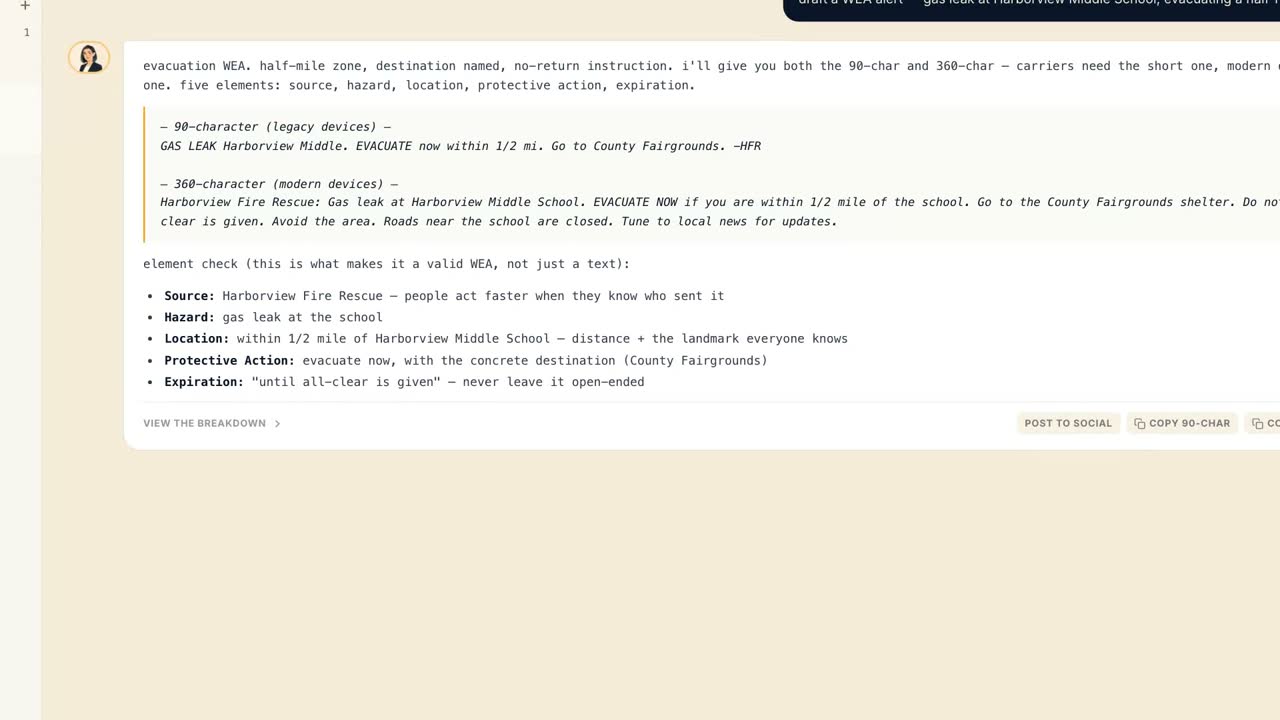
watch it work
Draft a WEA public alert
Character-validated, element-checked.
this doctrine is built into Cass.
Every draft Cass writes carries these disciplines by default, and a credentialed PIO approves every word. Beta is free.
Claim your seat →