
resources · incident communication
Holding the Line: the discipline of the long incident
By Corey Dierdorff, MPIO · July 11, 2026 · 7 min read
It is day nine of the search. No one has been found alive in days. The satellite trucks are thinning out, and your instinct, the same instinct your leadership has, is to slow down the briefings because there is nothing new to report.
That instinct is the trap. The families did not stop needing you when the news stopped.
A long incident is not won by the update that breaks news. It is held by the update that arrives on time when there is no news at all. Reliability is the product you are delivering. Information is just what you carry in.
The discipline of the empty update.
In a long incident the communications job changes underneath you. Early on, your value is speed. By the second week, your value is endurance, and that takes a different discipline.
- Set a fixed rhythm and hold it. Same time, same channel, every day. The public should be able to set a watch by you. The rhythm is what they lean on when the facts are scarce.
- Brief even when nothing changed. Name what is unchanged, name what continues, and name the next time you will be back. An update with no new facts still carries three things: presence, a status, and a next time. That is enough to hold the line.
- Protect the rhythm from the news cycle. Your cadence serves the affected community, not the camera count. The day you let the satellite trucks decide your schedule is the day you stopped working for the people who actually live there.
The hardest words.
The number on your card went up by four overnight. In an hour you will stand at a podium and say it. But before you say it to a single camera, four families have to hear it from a person who looked them in the eye, not from the chyron scrolling under your face.
Get that order wrong one time and you have done a second harm to people already living the worst day of their lives. Three disciplines hold this part of the job together.
- Families first, then the public. Confirmed deaths and identifications reach families through the proper notification process before they are ever spoken publicly. You build your public cadence around that order, never ahead of it.
- Numbers are people. We have lost four members of our community carries differently than the death toll is now four. Do not let the update become a scoreboard.
- Do not speculate on the dead or the cause. Identities come from the medical examiner. Causes come from the investigation. A PIO who guesses at either, to fill air, can retraumatize a family and corrupt an investigation in a single sentence.
Compassion is not the opposite of discipline here. It is the discipline. The most caring thing you can do is also the most rigorous: confirm, notify, then speak, and speak about people.
One incident, many badges.
By noon there are six agencies on the scene and four of them have a press office. The Coast Guard is talking about the search. The state is talking about the bridge. A federal team just landed, and a city official is already on camera guessing at a cause. Every one of them is right about their own piece, and the public is hearing six incidents instead of one.
A big incident does not fail for lack of information. It fails when too many people share it badly. The fix has a name: the Joint Information Center. One set of agreed facts, one release process, one voice carrying many badges.
Three disciplines make a JIC work.
- One set of agreed facts. Before anyone speaks, the agencies align on what is confirmed and who owns each piece. A fact released by one is a fact owned by all of them.
- Stay in your lane, and say whose lane it is. The search belongs to the Coast Guard. The cause belongs to the investigation. Naming the owner stops the freelancing and tells the public exactly where each answer will come from.
- One release process. Joint statements run through the JIC so two agencies never contradict each other in public. Speed within a process beats speed against it.
The public can absorb a huge, multi-agency response. What it cannot absorb is six agencies disagreeing on the facts in real time.
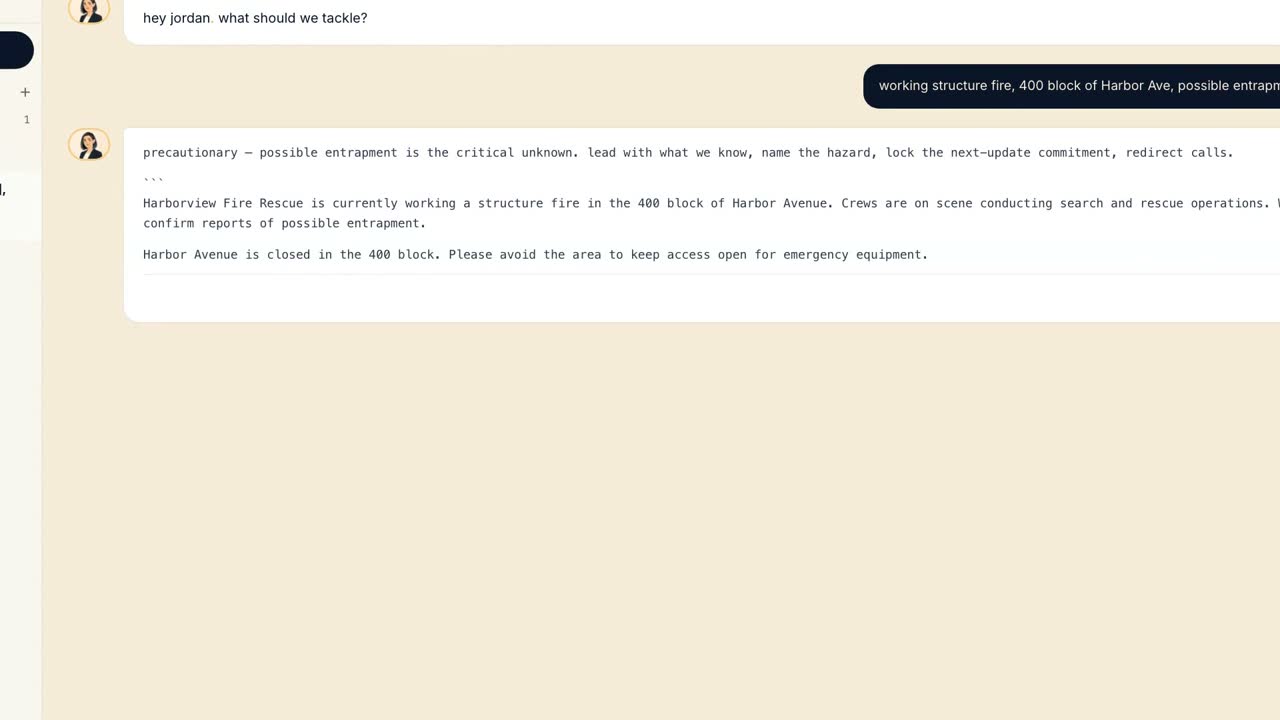
watch it work
Draft a hold statement
First words out, while facts are still coming in.
this doctrine is built into Cass.
Every draft Cass writes carries these disciplines by default, and a credentialed PIO approves every word. Beta is free.
Claim your seat →