
resources · rumor control
Rumor Control Under Live Pressure
By Corey Dierdorff, MPIO · July 11, 2026 · 7 min read
The first report is wrong. You know it is wrong. You also cannot prove it is wrong yet, because the one person who can confirm the real number is still on the phone with the medical examiner. So you wait, the careful way, the way the manual tells you to.
And while you wait, the wrong number is sprinting. It is on three local pages, a national account just quoted it, and a reporter is asking you to confirm a figure you have never said.
Rumor moves at the speed of emotion. Verified information moves at the speed of confirmation. Your job is not to win that race on accuracy alone. It is to be present in the space early enough that the public has a credible voice to hold onto before the rumor becomes the story.
Why the vacuum wins.
Three things make an unfilled space dangerous, and none of them are about how good your eventual statement is.
- Rumor is faster. It has no confirmation step. It is published the instant someone feels it is true.
- Rumor is satisfying. It answers the question people are asking right now, and a frightened public would rather have a terrible answer than no answer.
- Rumor compounds. Each share adds a witness. The tenth person to repeat it sounds like confirmation, not repetition.
You cannot out-accurate a head start. What you can do is refuse to leave the space empty. Holding the space sounds like this: We are aware of reports about X. We have not confirmed those figures and we will not repeat numbers we cannot stand behind. Here is what we can confirm right now. Here is when you will hear from us next.
That statement carries almost no new facts. It still works, because it plants a credible flag in the ground the rumor wanted for itself.
Name it, do not feed it.
Picture the correction that made it worse. You see a false claim with two hundred shares. You quote it and write FALSE across the top. Six hours later your correction has fifty thousand impressions, and so does the claim, because every person who saw your correction also saw the claim, many for the first time.
You did not kill the rumor. You introduced it to a stadium.
A correction is a megaphone. Whatever you put inside it gets louder, including the lie. The goal of a correction is not to prove the rumor wrong. It is to leave the audience holding the truth.
The cleanest tool is the truth sandwich, and it has three parts in a fixed order.
- Lead with the truth. State the accurate fact first, plainly, as the headline. This is what the reader should walk away holding.
- Name the falsehood once, framed as false before you state it. A claim circulating that X is not true. One pass, never in the first line.
- Return to the truth, and add what to do. Close on the accurate fact again, plus where to get verified information.
Two rules ride on top. Keep the false claim out of your headline, your first sentence, and your image, because those are the parts that travel when someone shares without reading. And do not name a wrongly accused person to clear them when a denial works without the name.
Rumor control is a system.
By the third day you are not chasing rumors anymore. You are drowning in them. Forty claims a day, each one a small fire. You cannot answer all of them, and you should not try, because some of them have nine followers, and answering would introduce them to ninety thousand.
A standing rumor-control function runs four steps, over and over.
- Monitor. Watch the channels where your public actually talks, not only the ones you post on. You are hunting for velocity, the rumor that is gaining, more than the rumor that merely exists.
- Triage. Not every rumor earns a response. Weigh three things: is it gaining traction, is it believable enough to spread, and could it cause real harm. A claim with all three gets a correction. A fringe claim with no traction gets starved.
- Correct. When you do engage, use the truth sandwich and push it through every channel at once, anchored to one official source.
- Log. Keep a running record of what was claimed, what you said, and when. The log becomes your timeline if anyone asks later.
Silence is a tool, not a failure. Some rumors die from lack of oxygen, and answering them is the mistake.
Get there before the rumor does.
The strongest move in rumor control happens before the rumor exists. Every disaster type has its recurring rumors. After a flood: aid scams, fake price-gouging numbers, claims that help is being withheld from certain neighborhoods. Before a storm: false evacuation orders and bogus shelter closures. You already know most of what is coming.
Pre-bunking sounds like this: In the next few days you will probably see posts claiming X. That is not true, and here is how to spot it. When the rumor then arrives, you are not correcting from behind. The public was warned by you first, and the lie lands on prepared ground.
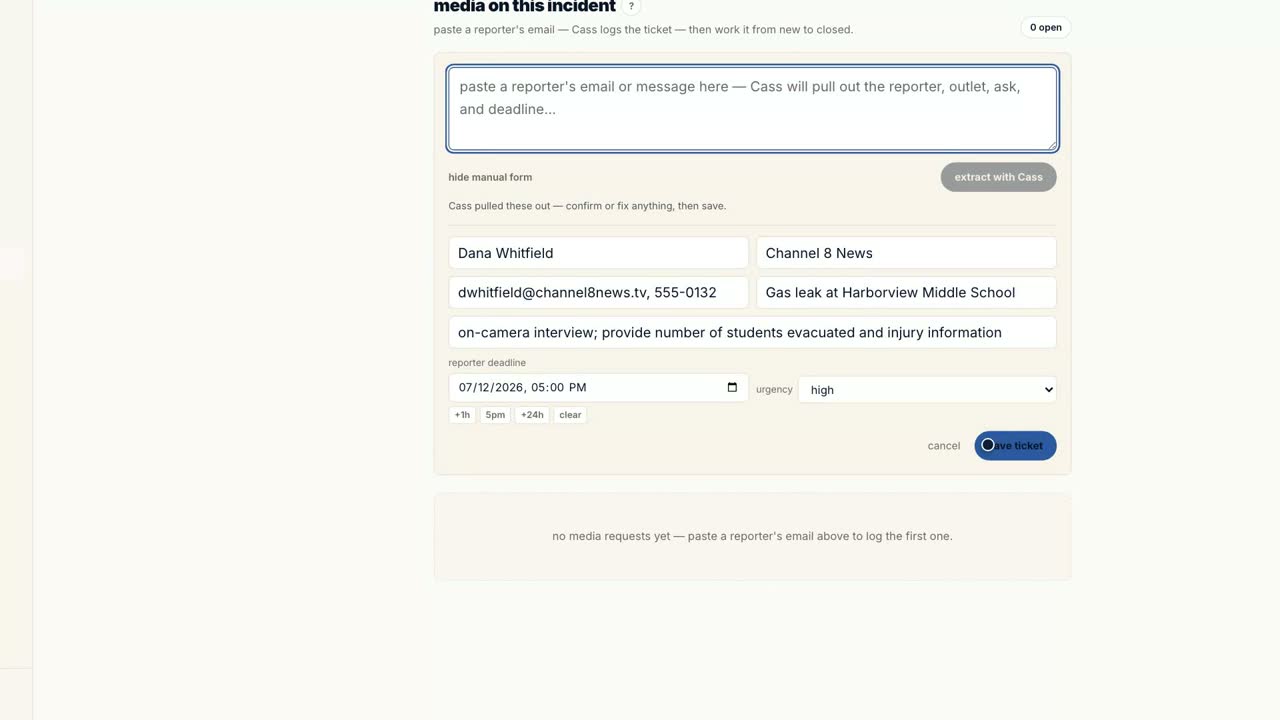
watch it work
Media requests on the clock
No deadline falls through.
this doctrine is built into Cass.
Every draft Cass writes carries these disciplines by default, and a credentialed PIO approves every word. Beta is free.
Claim your seat →