
resources · incident communication
The All-Clear Trap: why “safe” is the most expensive word a PIO can say
By Corey Dierdorff, MPIO · July 11, 2026 · 7 min read
The fire is out. The plume that hung over the town for two days is gone, and the news crews want the shot of a family walking back into their house. Your leadership wants the win. The air monitors near the site read below detection. And your inbox is filling with residents describing headaches and a chemical smell that will not leave their kitchens.
Everyone in the room wants you to say one word. Safe. It is the single word you can least afford to get wrong.
Safe is not a description. It is a promise. When you tell people an area is safe and someone gets sick, you have not just made an error. You have spent the credibility you need for every warning you will ever issue after this one.
The asymmetry of the all-clear.
The two ways to be wrong about safety do not cost the same.
Under-reassure and you keep people cautious a little longer than they strictly had to be. The cost is inconvenience, some lost time, some frustration.
Over-reassure and you send people back into a hazard. The cost is exposure, illness, and a community that will not trust your next warning.
Those are not the same size. So on the all-clear you bias toward caution every time, and you do it on purpose. Two habits make that real.
Say what you can confirm, not what you hope. Crews have extinguished the fire and the visible threat is gone. That is a fact you can stand behind. The area is safe is a claim you may not have earned yet.
Let the people who own the data make the safety call. Air and water safety belong to the environmental and health experts. The PIO does not manufacture an all-clear. The PIO carries one the experts have signed, and names them while doing it.
Safe is a technical claim.
Remember the podium, the glass of tap water, and an official taking a slow, deliberate sip for the cameras. The water is safe to drink. Across the city, parents were looking at the rash on a child's skin and the brown tint in the bathwater and wondering who to believe. The word safe was said out loud, on the record, with a prop. The testing did not support it. The distance between that sentence and the water coming out of those taps became one of the longest public-health failures in memory.
Four questions live inside the word safe. Answer them, or do not use it.
- For whom? Safe for a healthy adult is not safe for an infant, a pregnant resident, or someone with asthma. Name the vulnerable groups on their own terms.
- From what? Below detection for one chemical is not safe from everything. Say which hazard the reading covers and which it does not.
- Based on what? Attribute the data and the authority every time. EPA monitoring shows. The health department has determined. A safety claim with no source behind it is just a hope in a suit.
- For how long? Conditions change. Safe at today's reading and safe for good are different claims. Say which one you mean.
And hold this alongside all four: people reporting symptoms are information, not an inconvenience. When what residents are living contradicts what the instruments say, you investigate that gap out loud. You do not deny it to protect the message.
Reentry and the long tail.
Three weeks after a derailment, the satellite trucks are gone and the story has moved on. The town has not moved anywhere. Wells are still being tested. A parent is still wiping a second nosebleed of the week. At a half-empty community meeting, the anger in the room is not really about the fire anymore. It is about being told everything was fine and then left alone with the questions.
The incident the public will remember is not the day it happened. It is the months that came after. Running the long tail takes five disciplines.
- Phase the reentry, and say that it is phased. You can return is rarely a single moment. Communicate reentry in stages tied to conditions, and name what each stage does and does not mean.
- Keep the monitoring visible. Publish results on a steady cadence, including the boring still-normal updates. A predictable recovery schedule kills the vacuum the same way it did on day one.
- Name the unknowns honestly. We do not yet know the long-term effects, here is what we are doing to find out, and here is who to call beats a confident everything-is-fine that the next bad result will detonate.
- Take symptom reports seriously, on the record. A public channel to report problems, with visible follow-up, turns anger into cooperation.
- Do not declare victory. The closing note of an incident is not that it is over and it was fine. It is here is where we are, here is what continues, and here is how to reach us.
People will forgive a hard incident handled honestly. They will not forgive being reassured and then abandoned.
watch it work
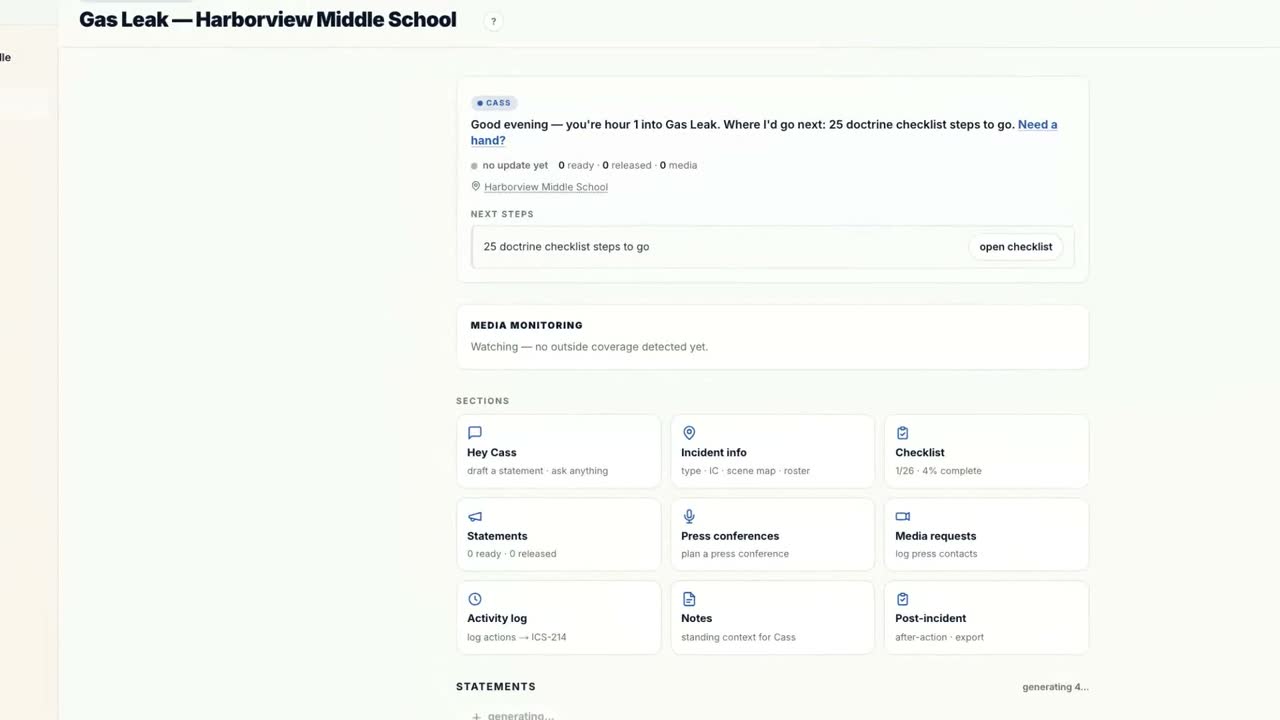
Open an incident command center
One screen runs the whole response.
this doctrine is built into Cass.
Every draft Cass writes carries these disciplines by default, and a credentialed PIO approves every word. Beta is free.
Claim your seat →