
resources · records & transparency
The Records Era: communicating when everything is public
By Corey Dierdorff, MPIO · July 11, 2026 · 7 min read
There is video. There is almost always video now. Body cameras, a bystander's phone, a doorbell, a traffic pole. Whatever happened, a record of it exists, and that record is going to become public.
Not maybe. The only thing you actually get to decide is whether the public sees it the way you released it, with context and warning and care, or the way it leaked, stripped of everything but the worst ten seconds.
Assume every record will be public, and plan from there. A PIO who waits to be forced into release has already lost the narrative to whoever leaks it first.
Plan the release you cannot avoid.
The mindset shift is everything. Stop asking whether you can keep it from coming out and start asking how to release it well. Once you accept that the record is going public, your whole job changes from defense to preparation.
- Acknowledge the record exists. Confirming there is footage, early, takes the power of revelation away from a leaker.
- Set expectations. Tell people it is coming, roughly when, and that it is hard to watch. A forewarned public is a steadier one.
- Prepare the context. Release the footage with the facts that frame it: what is known, what is still under investigation, what the public should understand. The worst ten seconds should not have to speak for the whole truth alone.
- Choose your timing on purpose. Release on a deliberate schedule, coordinated with the investigation and the affected family, not on the timeline a leak forces on you.
A leak releases the footage and nothing else. A managed release brings the footage out wrapped in context, warning, and care. Same video, two completely different things received by the public.
Transparency versus the investigation.
There are two true things in tension, and you are standing on the line between them. The public has a right to know what happened, and the louder the silence, the more they assume the worst. And the investigation, the prosecution, the fair process owed to everyone involved, can be wrecked by the wrong fact released at the wrong moment.
A legitimate investigative hold and a cover-up can look identical from the outside. The only thing that separates them, in the public's eyes, is whether you explained the hold.
You will have to withhold things in a live case. The failure is not the withholding. The failure is withholding without a reason the public can see. For every hold, give three things.
- The principle. What value the hold serves: an active investigation, a fair trial, a family's notification, a victim's privacy, public safety.
- The process. Who decides, and what has to happen before release.
- The horizon. When, roughly, the public can expect it, and a promise to update if that changes.
And here is the line you do not cross: do not let the investigation become a blanket excuse for opacity. We cannot comment on an active investigation, said reflexively about everything, is how a real principle gets burned into a punchline. Release what you can, hold only what genuinely needs holding, and prove you know the difference.
The public will forgive a hold they understand. They will never forgive a hold you would not explain.
The dignity of the record.
Most of the records era pushes one direction: get it out, get ahead of it, the public has a right to see. And then you hit the records that can wound. The crime-scene image that would turn a child into a headline. A killer's writings whose release might broadcast a blueprint and a trophy. The footage whose only new information is a family's worst moment.
Lean toward transparency, always. But the default yields when releasing a record, in a given form, would cause harm out of proportion to what the public actually gains. Before release, ask four questions.
- What is the genuine public interest? The thing the public needs to understand or to hold power accountable, not just wants to see.
- What is the real harm? To the families, to the dignity of victims, to public safety, to the risk of inspiring a copycat.
- Is there a less-harmful form? A summary, a redaction, a delay, a description instead of the raw image, that serves the interest with less damage.
- What do the affected families say, and how heavily does that weigh?
Need to know is not the same as want to see. The public's right to know is about understanding what happened and holding power accountable. It is not a right to consume a family's worst moment as content.
Releasing everything is not courage, and withholding with a reason is not a cover-up. On the hardest days, protecting the dignity of the people in the record is the job.
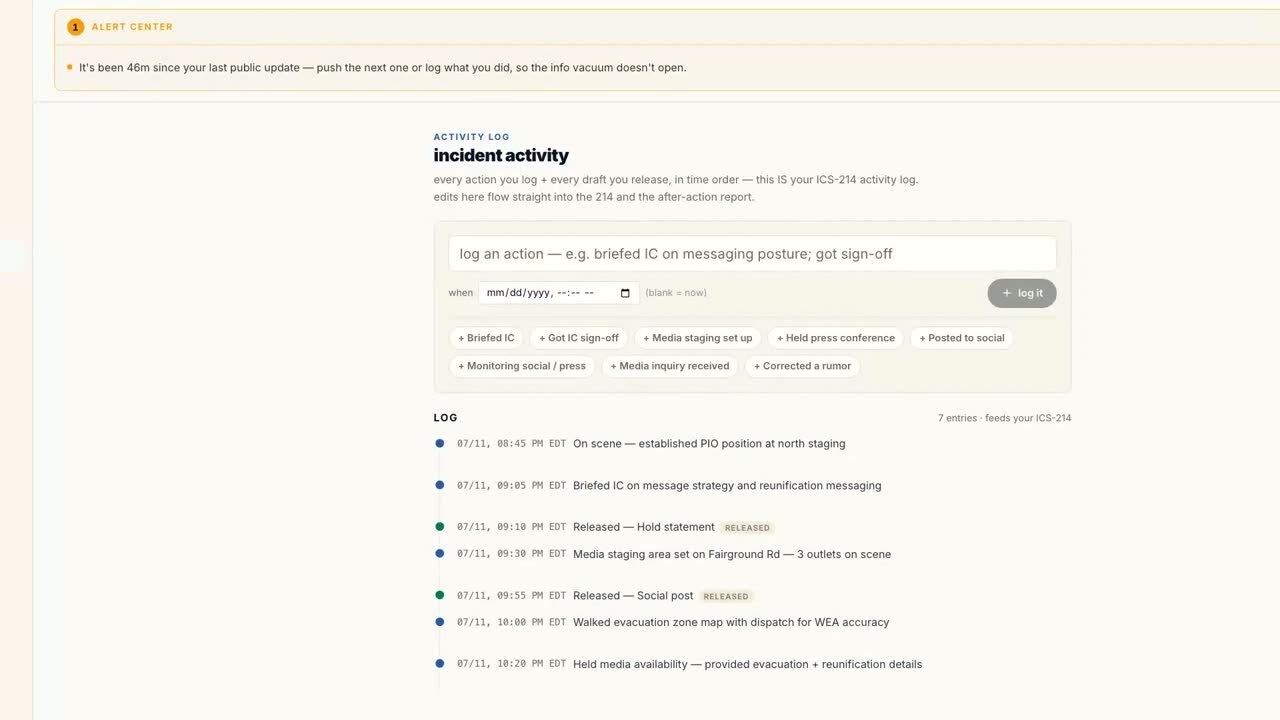
watch it work
The ICS-214 keeps itself
One tap logs the action. The form writes itself.
this doctrine is built into Cass.
Every draft Cass writes carries these disciplines by default, and a credentialed PIO approves every word. Beta is free.
Claim your seat →